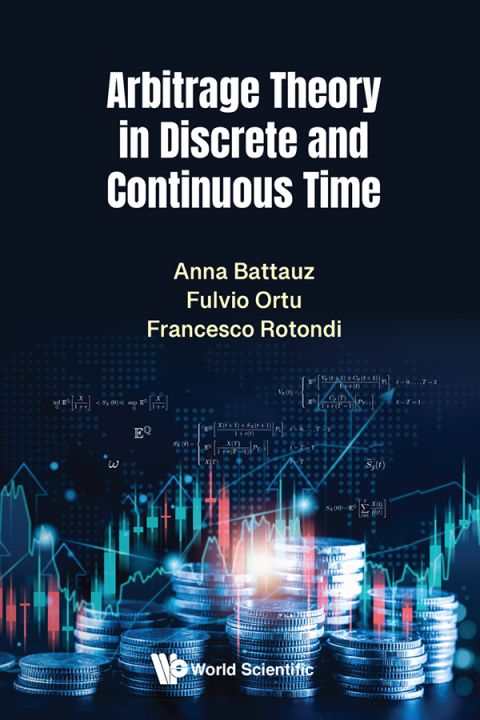
ARBITRAGE THEORY IN DISCRETE AND CONTINUOUS TIME
Buy with confidence
✓ Digital eBook
✓ Dedicated customer support
✓ Refund if we cannot fulfill your order
In the ever-evolving world of finance, no-arbitrage theory remains a cornerstone for understanding asset pricing, risk management, and investment strategies. This book presents the key results of modern no-arbitrage theory in both discrete and continuous time settings. The book is structured in three parts. The first part focuses on one-period financial market models. Although highly stylized, this framework provides a clear and explicit introduction to the fundamental features of a financial market, such as the absence of arbitrage and market completeness, as well as the tools used to effectively test these properties. Additionally, we explore how the absence of arbitrage imposes constraints on the pricing of new financial assets. The second part transitions to multi-period financial market models, offering a more realistic depiction of financial markets. It introduces the fundamentals of discrete-time stochastic processes, extends the tools developed in the first part, and demonstrates how to price contingent claims with cash flows occurring at multiple dates. In the third part, we refine the time structure further by moving into a continuous-time setting. After a primer on continuous-time stochastic processes and stochastic integration, we extend the no-arbitrage framework and rigorously examine pricing in the celebrated BlackScholes model and in a few of its extensions. Numerous numerical examples throughout the book support the reader’s understanding and help visualize key concepts. Each part concludes with a comprehensive set of exercises and solutions, offering opportunities for practice and self-assessment. Contents: Readership: MSc students in economics and finance seeking a rigorous treatment of derivatives pricing; BSc students in mathematics or related disciplines looking for an introduction to mathematical finance; PhD students in economics and finance; Professionals and practitioners involved in the valuation of financial instruments.About this book
Book details
Related products